Does Your Hotel Really Need Meta Search in 2026? Here's the Truth
/![[HERO] Does Your Hotel Really Need Meta Search in 2026? Here's the Truth](https://cdn.marblism.com/Ug0PkDz1VC3.webp)
Let's cut through the noise: Yes, your hotel absolutely needs meta search in 2026, but probably not for the reasons you think.
We've watched this channel evolve from a "nice-to-have experimental tactic" to the single most critical battleground for direct bookings. And if you're still treating it as optional? You're handing your highest-intent guests to OTAs on a silver platter. Let's unpack why meta search has become non-negotiable, how it got here, and where it's headed next.
The Evolution: From Price Comparison to Conversion Machine
Remember when TripAdvisor was just reviews? When Trivago's catchy commercials made us all meta search-curious? That was 2010–2015, the "price comparison era." Travelers used these platforms to window-shop, compare rates across dozens of sites, and then, frustratingly for hoteliers, often booked on Booking.com or Expedia anyway.
Back then, meta search felt like a low-priority marketing experiment. The conversion rates were abysmal (under 1%), tracking was a nightmare, and most properties treated it as a side project for the revenue manager's intern.
But somewhere between 2018 and 2022, meta search quietly transformed into a direct booking powerhouse. Google Hotel Ads integrated directly into search results. TripAdvisor built instant booking functionality. Kayak and Trivago refined their bidding algorithms. Suddenly, these platforms weren't just sending traffic, they were converting it at rates that made traditional Google Ads look sluggish.
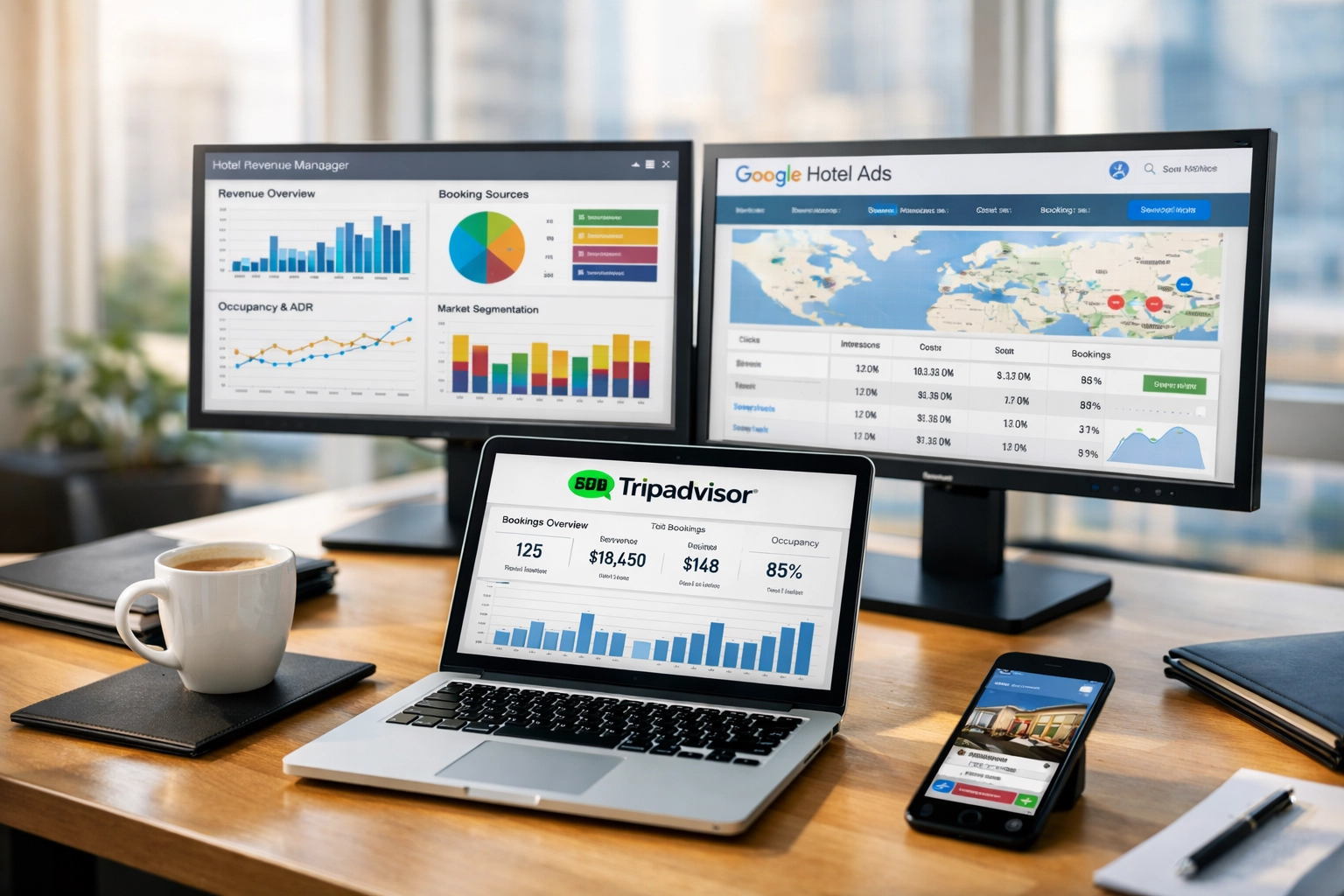
The real turning point? When Google started showing hotel modules for brand-name searches. Now when a guest types "Hotel XYZ Mumbai," they don't just see your website, they see a comparison grid with OTAs actively bidding on your brand term. Game. Changed.
The 2026 Reality: Meta Is the New OTA
Here's what we're seeing across properties in 2026: meta search has essentially become the primary distribution battleground, and it's no longer optional for any hotel serious about driving direct bookings.
Let's talk numbers, because the data is wild:
Conversion rates on meta search now hit 6–18% consistently, with high-intent brand searches pushing past 20%. Compare that to generic Google Ads (1–3%) or social campaigns (0.4–1%), and the ROI story writes itself. When someone searches for your hotel by name on Google and clicks through from the hotel module, they're 85–95% decided on booking with you. They know your location, they've read your reviews, they've mentally allocated the budget. They just need friction-free confirmation that your rate matches what they saw on Booking.com.
And here's the kicker: over 70% of brand-intent hotel searches now route through Google's hotel modules where OTAs are actively bidding. If you're not visible there, you're invisible to your own audience.
CPC vs. Commission: The Model That Matters
Unlike OTAs that take 15–25% commission per booking, meta search operates on a cost-per-click (CPC) model. You only pay when someone clicks to your booking engine, not when they actually book. This fundamentally changes the economics.
We've seen properties cut their effective commission rate from 18% (OTA average) to 3–7% (meta search + booking engine costs) while maintaining or increasing room nights. The savings compound fast, especially for high-ADR properties or extended-stay bookings where OTA commissions become painful.
But here's the nuance: meta search only works if your tech stack is tight. Rate parity must be accurate. Your booking engine must load in under 2 seconds. Mobile experience must be flawless. One clunky step, and that 18% conversion rate drops to 4%, and suddenly you're burning budget with nothing to show for it.
The Numbers That Actually Matter
Let's be honest, hoteliers don't care about "impressions" or "engagement metrics." We care about revenue, ADR, and profitability.
Meta search delivers on all three:
- Higher ADR: Direct bookings via meta search typically achieve 8–12% higher rates than OTA bookings, because you control the pricing and packaging.
- Lower cancellation rates: Guests who book direct after comparing options tend to stick with their reservations (15–20% lower cancellation rates in our analysis).
- Cross-sell opportunities: Direct bookers are 3x more likely to add spa treatments, dining packages, or airport transfers because they're booking on your platform where upsells are visible.

But here's where properties mess up: they treat meta search like a set-it-and-forget-it channel. The winners? They're obsessively tracking ROI by source, adjusting bids daily based on occupancy forecasts, and A/B testing landing pages like their lives depend on it. Because in 2026, they kind of do.
The AI-Powered Future: Where We're Actually Headed
If you think meta search is just about Google Hotel Ads and Trivago grids, you're already behind. The next 18–24 months will completely reshape how travelers discover and book hotels, and AI search assistants are the catalyst.
Google's Gemini, OpenAI's SearchGPT, and similar tools are moving beyond traditional "10 blue links" search results. Instead of showing you a comparison grid, they'll synthesize personalized recommendations based on your search history, travel patterns, budget signals, and even sentiment analysis of your queries.
Picture this: A traveler says, "Find me a boutique hotel in Goa under ₹8,000 per night with a good pool, walking distance to beach, that's not too loud." Instead of a grid with 47 properties, the AI assistant returns 3–5 curated options with natural language explanations: "I'd recommend Alila Diwa, their infinity pool overlooks paddy fields, it's a 7-minute walk to Majorda Beach, and past guests mention it's quieter than most Goa resorts. Currently ₹7,200/night."
Voice-activated booking is already here with Google Assistant and Alexa integrations, but adoption is still under 5%. By 2027, we expect 15–20% of hotel bookings will initiate via voice, especially for business travelers booking last-minute or families planning road trips.
The implication? Properties that invest in structured data, rich content, and AI-readable reviews will dominate these AI-curated results. Those relying on old-school SEO tactics and static images? They'll be invisible.
Operational Impact: Budget Shifts and Tracking Chaos
Let's talk operations, because this is where the rubber meets the road.
Budget reallocation is the first domino. Properties are shifting 20–40% of their OTA commission spend to meta search marketing budgets. A 150-room hotel paying ₹50 lakhs annually in OTA commissions might reallocate ₹15–20 lakhs to Google Hotel Ads and TripAdvisor CPC campaigns. The math works if conversion rates hold.
But tracking ROI becomes messy. You're now juggling:
- Google Hotel Ads dashboard
- TripAdvisor Sponsored Placements
- Trivago CPC campaigns
- Your booking engine analytics
- PMS reservation data

Without a unified attribution model, you're flying blind. We've seen properties double-count bookings, misattribute conversions, and make budget decisions based on incomplete data. The solution? Invest in a channel manager or business intelligence tool that consolidates meta search performance with direct and OTA bookings in one view.
Rate parity becomes mission-critical. If your website shows ₹5,000/night but Booking.com shows ₹4,800, meta search traffic will click away in seconds. Parity monitoring tools (like OTA Insight or RateGain) are no longer optional, they're table stakes.
Customer Satisfaction: The One-Stop-Shop Dream
From a guest perspective, meta search in 2026 is a dream. They get price transparency, real-time availability, and one-click comparison across 20+ booking sources without opening 47 browser tabs.
The "Book on Meta" functionality (especially on Google Hotel Ads) lets travelers complete bookings without ever leaving Google. They click, see your rate, enter payment details, and receive confirmation, all within the hotel module. Friction? Minimized. Confidence? Maximized.
But here's the customer-satisfaction wildcard: personalization. AI-powered meta search results are starting to factor in past booking behavior, loyalty status, and even device usage patterns. A traveler who always books ocean-view rooms will see those options prioritized. A business traveler searching on Monday morning will see properties near conference centers with fast Wi-Fi highlighted.
This creates a paradox for hoteliers: guests love the personalized experience, but you lose control over how your property is positioned. Your beachfront resort might get buried if the algorithm decides the traveler prioritizes "quiet" over "beachfront." The winners will be properties that optimize their metadata, descriptions, and amenity tags to match diverse traveler intents.
Employee Satisfaction: The Underrated Benefit
Here's an angle most discussions skip: meta search improves employee satisfaction by delivering better lead quality.
Think about it. When a front desk agent or reservations team member fields a call from someone who found you via a vague Google Ad, they're often starting from scratch: explaining location, amenities, pricing, policies. It's exhausting and time-intensive.
But a guest who clicked through from Google Hotel Ads or TripAdvisor? They've already compared rates, read reviews, and made 80% of their decision. The employee's job shifts from "convincing" to "confirming." Less friction. Fewer cancellations. Lower stress.
We've heard from reservation managers that meta search leads require 40% less handling time on average and have significantly lower modification/cancellation rates post-booking. That translates to happier, less burned-out staff, which in an industry battling retention challenges, is not a small win.
The Verdict: No Longer Optional
So back to the original question: Does your hotel really need meta search in 2026?
If you care about direct bookings, profitability, and not hemorrhaging brand-intent guests to OTAs, then yes, unequivocally. Meta search has evolved from experimental channel to core distribution strategy. It's where your highest-intent guests are searching, where conversion rates outperform every other paid channel, and where the future of AI-powered discovery is being built.
But here's the caveat: meta search only works if you do it right. Accurate rates, fast booking engines, obsessive tracking, and constant optimization. Treat it like a side project, and you'll burn budget with nothing to show. Treat it like the revenue-driving machine it is, and you'll wonder how you ever survived without it.
The shift from OTA dependence to meta search dominance is happening whether you're ready or not. The properties winning in 2026 aren't the ones asking if they should invest: they're the ones asking how much and how fast they can scale. That's where you need to be.
Researched and written by the hospemag research team. For more hospitality insights and trends, visit hospemag.me.